• Now that it’s 2017, I thought I’d look back and see if there are answers for the eight questions I asked a year ago about virtual reality in 2016. Here goes:

    “How big will the market for VR be a year from now?”
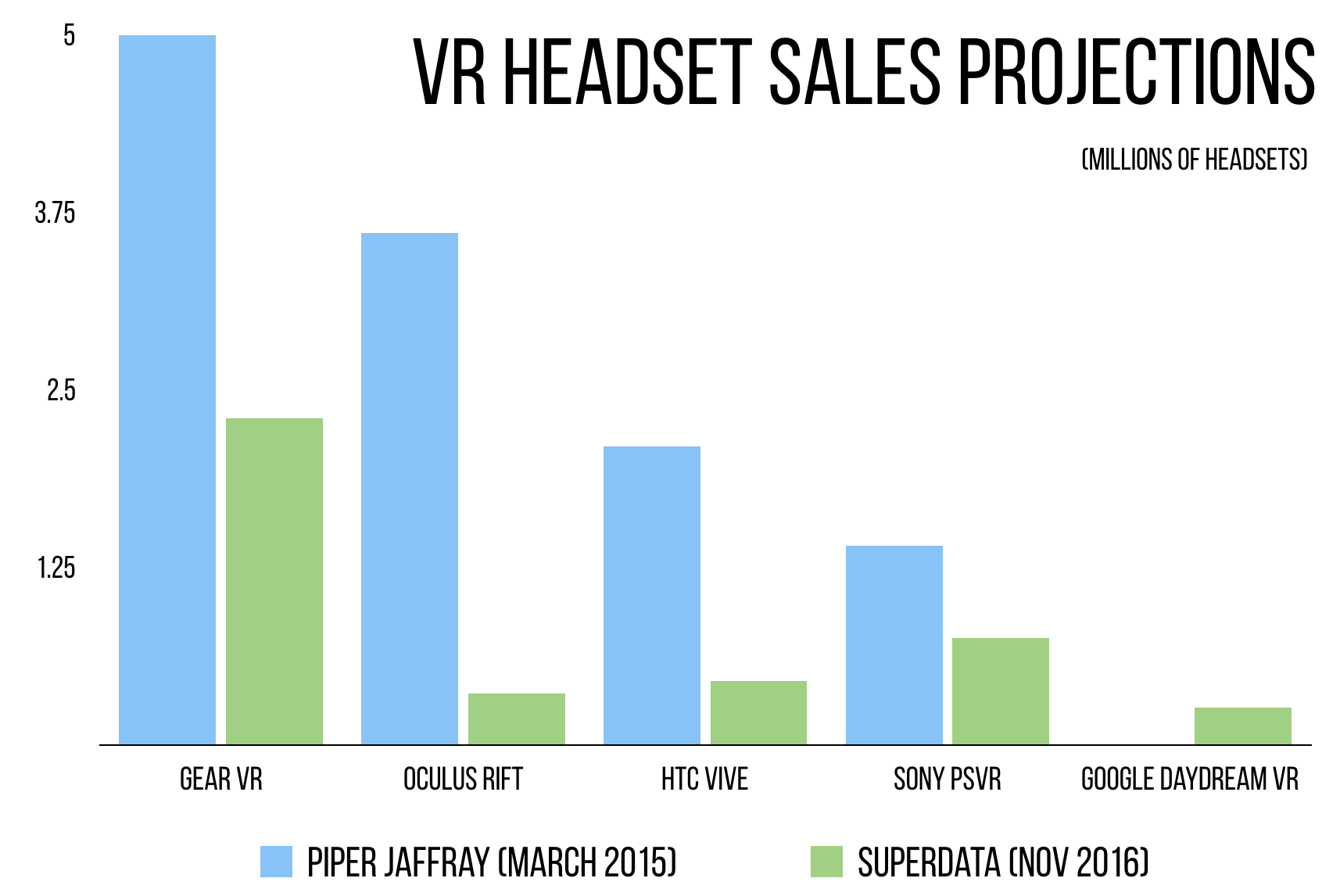
    This isn’t an easy to question to answer right now. My guesstimate a year ago was that by the end of 2016 there would be around 10 million active users of VR. I absent-mindedly didn’t think to define what I meant by “active user” — I suppose I meant someone who uses VR at least a couple of times a month — but even if I had been more specific, I haven’t seen any reliable numbers on how many people are regular users of VR anyway.

    The most reliable-looking numbers I could find were some recent estimates of headset sales from SuperData Research, a research firm based in New York. They released 2016 sales projections in November that put Samsung at around 2.3M Gear VR headsets, Sony at 745K PSVR headsets, Oculus at 350K Rift CV1 headsets, HTC at 420K Vive headsets, and Google at 260K Daydream headsets. That’s just over 4 million headsets. They also estimated overall there would be about 16 million VR users by the end of 2016, which means they’re almost certainly including people using really basic headsets like Google Cardboard to get to that number.

    We can debate whether or not very basic headsets like Cardboard should “count”, but if I’m being honest I wasn’t including them when I came up with my guess of 10 million VR users by the end of 2016. How did I get to that number? I figured that by the end of the year there would be 3-5 million Gear VR users, 3-5 million PSVR users, 1-2 million Oculus Rift owners, and 500k-1M HTC Vive owners. That’s not far off from projections that analyst firm Piper Jaffray made in 2015 (I’ve included those numbers in a chart alongside those from SuperData).

    Here’s where things get messy. Samsung announced at CES earlier this week that they’d shipped 5 million Gear VR headsets, more than double SuperData’s estimates. That does cast some doubt on the accuracy of their sales estimates for other headsets, but I don’t think anyone believes that sales of the Rift or Vive approached anywhere near Piper Jaffray’s projections.  

    We’re still in the very early days of VR — in my post a year ago I compared where we were to the smartphone market pre-iPhone — so perhaps it’s pointless to argue over whether headset sales falling below some analyst’s projections even matters. But one big difference between smartphones and VR is that even before the iPhone was announced it seemed inevitable to most observers that smartphones would become ubiquitous. It was just a matter of how and when, not if. With VR it is still very much an open question whether it will remain a relatively niche market or find a wider audience. How strong or weak sales are at this early stage aren’t determinative, but they do give us at least some indication where things are going. I’ll have more on this for my questions for VR in 2017.

    “Will headsets be a commodity or a source of competitive advantage?”

    Too early to say yet, but at the very least Oculus’ fully integrated model does seem like it’s due for a collision with Microsoft and Google’s strategies of working with OEMs to build cheap headsets. I doubt that we’ll have any idea of how this shakes out for a few years, but VR definitely doesn’t have a shot at going mainstream until you can buy a high-quality headset with room-scale positional tracking (which allows you to physically move around in virtual spaces, leading to a much more immersive experience) for less than a couple of hundred bucks.

    “Speaking of hardware, what will the relationship be between high-end and low-end VR?”
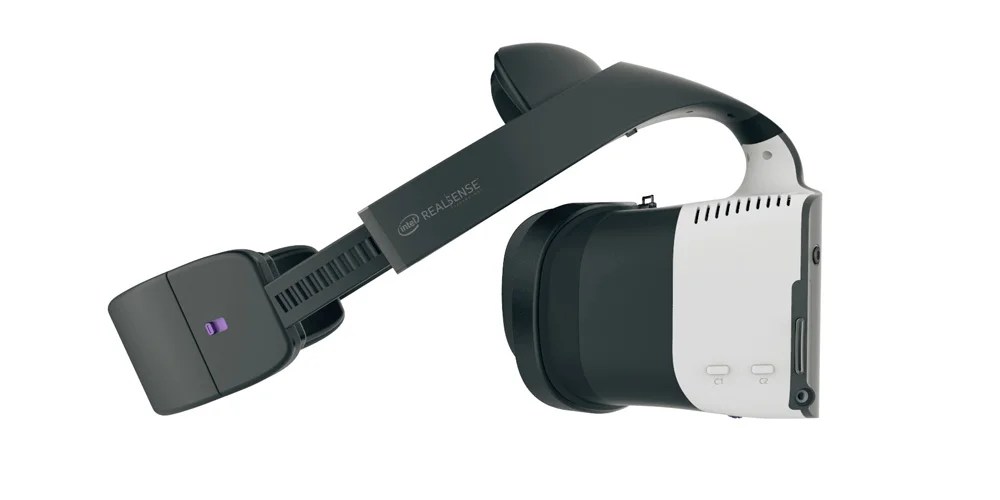
    There’s not much evidence that owning a Gear VR or Daydream headset leads to buying a Rift or Vive (or investing in a PC to power it), but 2016 did see Oculus teasing the “Santa Cruz”, a prototype of a self-contained mobile headset with inside-out positional tracking. This could end up being a sort of third category in-between the lower end stuff (which is powered by popping your smartphone into a headset) and the higher end stuff (which offers the best and most immersive experience, but which also requires a powerful PC with a dedicated GPU). Intel showed off an early version of headset along these lines code-named Project Alloy (pictured above), and Google is rumored to be working on something here as well. It’s possible that this will be how a lot of people get to experience true room-scale VR.

    “Will regular people create and share VR content? If so, how?”

    Even though Facebook and YouTube have started supporting it, very few people are sharing VR (and really we’re talking 360) photos and videos online. This is partly because you need a dedicated 360 camera for creation (apps for doing this on a smartphone are uniformly awful) and partly because even if you do share something it’s unlikely that your friends or family will have a headset for properly looking at what you’ve shared in 360. I looked at a number of startups building platforms for sharing 360 photos and videos, but ended up passing on all of them, partly because of how small the market still is and partly because of concerns that Facebook, YouTube, Instagram, etc will eventually drive a lot of this activity since they’re where people are already sharing and consuming photos and videos. Underscoring my point, Vrideo, which was building a YouTube-for-360-video, shut down late last year (betaworks was an investor, though this deal was made before I joined). They’d managed to aggregate one of the biggest audiences for VR content to-date and they still couldn’t find a way to make it work, and believe me, they tried. I’d love to find something great in this space, but the bar is very high.

    “Will there be an app which drives mainstream adoption?”

    Didn’t happen in 2016. But if you’re building this, definitely find me. That said, VR apps in general did shoot up the iOS App Store charts this past holiday season, which presumably means a lot of regular consumers received basic “pop your phone in” headsets as gifts and started giving VR a try.

    “What will be the user experience paradigms which define VR?

    This still feels entirely up for grabs, but we did see a ton of experimentation, particularly in gaming. Related to this, developers of social VR products and games were forced this past year to confront thorny issues around harassment in virtual environments. It’s not something which can be easily shrugged off, and while there is a long way to go, I’m starting to see some developers rolling out solutions to try and address the problem.

    “What will Microsoft end up doing?”

    Well, we got our answer, at least in part, with the announcement of Windows Holographic and the line of VR headsets which partners are making for it, but we still know very little about how VR will factor into the upcoming “Project Scorpio” Xbox due out before the end of the year.

    “What will Apple end up doing?”

    I’m highly skeptical that Apple is building a clear iPhone 7 for AR and VR, but apart from that rumor we don’t have a strong sense of what Cupertino is going to do here. We do know that a few months ago Apple CEO Tim Cook expressed skepticism about VR, saying that it, “Is not going to be that big compared to AR,” so it’s entirely possible they’ll continue to ignore the market and focus instead on launching something related to AR in a year or two (or possibly more).

    Ok, thanks for reading! I’ll be back with my questions for VR in 2017 in a few days.

  • I love podcasts, having been both an avid consumer and on-again-off-again producer of them for over ten years now. But what might surprise you, at least if you’re familiar with my work, is that the podcasts I love most are about history and that I almost never listen to shows about tech. Good history podcasts can be hard to find, especially as they tend to get buried in the “Education” category in iTunes and other directories, so I thought I’d share my list of shows I listen to. And please hit me up with any suggestions for podcasts I’ve missed that I should check out!


    History podcasts I listen to regularly:


    If you know any history podcasts you probably know Mike Duncan’s The History of Rome and Dan Carlin’s Hardcore History. Both are legendary, in terms of both their quality and how many other history podcasts they’ve gone on to inspire. If you haven’t listened to any history podcasts I’d suggest starting with these two.

    Hardcore History

    Dan Carlin’s Hardcore History isn’t just the best history podcast ever made, it’s a serious contender for best podcast of all-time. Dan only produces a few episodes a year, but each one is epic in scope and length (seriously, it’s not unusual for an episode to be three hours long) and is amazingly well-researched, engaging, and in-depth. Each episode or short series of episodes covers a specific topic, ranging from the Mongol Horde, to WWI, to the fall of the Roman Republic. If you’re only going to subscribe to one podcast from this list you have to make it this one.

    Revolutions

    The new series from Mike Duncan of The History of Rome fame, this one follows different revolutions throughout history, beginning with the English Revolution, then the American Revolution, the French Revolution, (the absolutely compelling, but little discussed) Haitian Revolution, and now is close to wrapping up his series on the wars of Latin American independence (I have a fourth great grandfather who fought on the losing side in Peru). This is one of the must-listens when it comes to history podcasts.

    My History Can Beat Up Your Politics

    I don’t listen to that many American history podcasts, but this show by Bruce Carlson hooked me because he does a masterful job of putting the political issues of today in historical context. He’s especially good at digging up bits of American political history that have mainly been forgotten (like obscure fights over the House Speakership in the late Nineteenth Century) that I find utterly fascinating.

    The Ancient World

    A series on ancient history by Scott Chesworth, this may be the most underappreciated podcast on this list. Now in its third season, for season one Scott did a wide-ranging survey of ancient civilizations, beginning with the rise of Sumeria and finishing up with Alexander the Great, looked at the archaeologists that rediscovered these civilizations in season two, and now in season three is tracing the family tree that begin with Cleopatra and will end with Queen Zenobia.

    The History of Byzantium

    There were more than a few people who wanted Mike Duncan to keep The History of Rome podcast going past the collapse of the Western Empire in 476 and follow the story all the way to the fall of Constantinople and the end of the Byzantine Empire in 1453. He didn’t do that, but it opened up the opportunity for someone else to tell the story and fortunately for us Robin Pierson jumped on it and started The History of Byzantium, which picks up right where Mike left off. I’d actually argue that as good as The History of Rome was, The History of Byzantium is the better of the two podcasts in that Robin tends to go into more depth and offer more context as he tells the story.

    History of the Crusades

    The audio quality is a little rough in the early episodes, but this series offers a balanced look at the Crusades, beginning with Pope Urban II’s call for the First Crusade in 1095 all the way until the fall of Acre in 1291. I found this about two-thirds of the way through the series and at one point was binge-listening to three or four episodes a day in an attempt to catch up. Host Sharyn Eastaugh has been continuing the series by looking at the crusade against the Cathars of southern France.

    The History of English

    This one is worth checking out even if you’re not all that interested in the origins of the English language — though you should be! The early episodes discussing the Indo-Europeans and the Proto-Indo-European language which is the source of not just English, but of Latin, Greek, Sanskrit, Persian, German, etc, are especially fascinating.

    10 American Presidents

    A series that plans to do shows on ten different American presidents, each with a different history podcaster handling narration duties. Mike Duncan of The History of Rome and Revolutions did the first episode on George Washington and Dan Carlin of Hardcore History followed up with an episode about Richard Nixon.

    History of the Papacy

    I’m not religious, but the history of the early Christian Church is a lot more interesting than you’d think. Host Stephen Guerra does an excellent job of teasing out the intricate theological debates that raged during this era, as well as how events intersected with the wider historical landscape.

    A History of Europe – Key Battles

    A series that looks at key battles that were turning points in the history of Europe, beginning with the Battle of Marathon. Host Carl Rylett doesn’t offer as much of a blow-by-blow of the battles themselves as he does on the political and historical events leading up to the battles (which is totally fine with me).

    The Podcast History of Our World

    Doing a podcast about the entire history of the world is pretty ambitious, so don’t expect as much depth as you’d get on a more focused show, but this one is an enjoyable survey that’s 70 episodes in and just now getting to the Romans. Not updated very regularly any more.

    Wartime

    Hosted by historian Brady Crytzer, each season of Wartime focuses on different topic. The first covered the French & Indian War, the second the empires of the ancient world, the third the American Revolution, the fourth on “gamechanging” historical figures like Alexander the Great, the fifth on turning points like the Mexican-American War and the Battle of Midway, and the sixth on some of the lesser-known rebellions of colonial North America (for example I knew nothing about the Pueblo Revolt that took place in New Mexico in 1680). This one is less of a dates-and-battles podcast and more about understanding the forces that shape history. I’d start with Season 2.

    In Our Time

    A roundtable format podcast hosted by Melvyn Bragg for BBC Radio 4 that features a single topic per episode discussed by a panel of academics. This one isn’t just about history — they also cover science and culture — but they manage to cover topics ranging from the Gettysburg Address and Eleanor of Aquitaine to the Sikh Empire and Hatshepsut.

    New history podcasts (or that are new to me) that I recently started listening to and am excited about:


    History on Fire

    This is one of the few shows that consciously tries to emulate the depth, length, and even style of Dan Carlin’s Hardcore History (which is not a bad thing as far as I’m concerned). Only four (very long) episodes have been released so far, two on the Slave Wars of ancient Rome, one on the body of a Bronze Age ice man who was discovered in the Tyrol mountains a few years ago, and one that begins the story of the 10,000 Greek mercenaries who went to fight in a Persian civil war some 2,500 years ago. Host Daniele Bolelli, who teaches history, does have a strong Italian accent, but you sort of don’t notice it after a bit and I’m enjoying his shows.

    The Maritime History Podcast

    Begins with the earliest known seafaring activities (i.e. ancient Sumaria) and after a couple of dozen episodes is now up to the Phoenicians and Carthage.

    Wittenberg to Westphalia: Wars of the Reformation

    A promising new series on the religious wars of early modern Europe. The history of this era can be tough to untangle and I look forward to seeing how host Benjamin Jacobs handles it.

    The Almost Forgotten

    A show where each episode highlights a single individual who hasn’t exactly been lost to history, but who doesn’t get anywhere near the attention they deserve given the impact they had. Only ten episodes so far, but they’ve covered a number of fascinating figures, including Otto the Great, Chandrgupta Maurya, and Mithridates.

    Our Fake History

    A podcast about “myths we think are history and history that might be hidden in myths,” this one tackles stuff like whether the Chinese beat Columbus to the New World, was there actually a Trojan War, and who really killed Rasputin. Host Sebastian Major does a great job of being enthusiastic while skeptical.


    History podcast series that have ended, but that I recommend:


    The History of Rome

    A history of Rome in 179 episodes, all the way from its semi-legendary origins down to the fall of the Western Empire in 476. Almost every history podcaster points to this series as the one inspiring them to start their own podcast. Host Mike Duncan is now working on a new series called Revolutions (see above).

    12 Byzantine Rulers

    A limited series by Lars Brownworth that starts with Diocletian’s splitting of the Roman Empire into Eastern and Western halves and then tells the story of the surviving Eastern half as it becomes the Byzantine Empire through twelve of its most important rulers.

    Norman Centuries

    Another limited series by Lars Brownworth, this one on the impact the Normans of Northern France had on medieval Europe.

    A History of Alexander the Great

    Follows the life of Alexander the Great. Which I guess is self-explanatory. Hosted by Jamie Redfern, who also does A History of Hannibal.

    Belisarius – A History

    A series about Belisarius, a Byzantine general during the 6th century, is about as niche as a podcast can get, but the story of his life is absolutely fascinating, especially given how overlooked the period just after the fall of the Western Roman Empire is. Only sixteen episodes.


    Other history podcasts I subscribe to but don’t listen to frequently:


    BackStory

    One of the few podcasts specifically about American history that I subscribe to. Each episode is on a single topic related to American history or culture, like alcohol, shopping, or oil.

    Ancient Warfare Podcast

    This one is an offshoot of Ancient Warfare magazine and features a roundtable discussion of the theme of the magazine’s latest issue. Audio quality can be rough, but where else are you going to get a show about the Seleucid Empire, the organization of the Assyrian army, or the Roman conquest of Spain?

    History Extra

    A weekly podcast produced by the BBC History Magazine. Focus is mainly on British history — which is not unexpected — but the interviews with history scholars are engaging no matter what the topic.

    History Books Review

    Mainly an extended review of Gibbon’s Decline and Fall of the Roman Empire mixed in with the occasional episode on another history book. Irregularly updated.

    A History of Hannibal

    By Jamie Redfern, who also produced A History of Alexander the Great. Not just a recounting of Hannibal’s exploits, this one provides a lot of background on how Rome and Carthage ended up at war.

    Life of Caesar

    Covers the life of Julius Caesar, just like it says. Though now that they’ve reached the Ides of March they’ve moved on to the life of Augustus. Co-hosts Cameron Reilly and Ray Harris have a pretty conversational style which some people don’t care for.

    The Napoleon Bonaparte Podcast

    An earlier series by Cameron Reilly, this one with co-host J. David Markham.

    Ask Historians

    An off-shoot of the AskHistorians subreddit. Audio quality can be rough, but the breadth of topics is great.

    The British History Podcast

    An astonishingly in-depth series covering the entire history of Britain that kicks off about 70,000 years ago and after 227 episodes is only up to King Alfred.

    The Egyptian History Podcast

    Like The History of Rome, but about Egypt.

    The History of Iran

    This is a series that held out so much promise — I personally find the history of Iran and ancient Persia to be fascinating — but new episodes are posted infrequently.

    When Diplomacy Fails

    This show does short series on various wars and conflicts (the Seven Years War, the the Franco-Prussian War, World War I, etc), but looks mainly at the events leading up to the outbreak of hostility rather than the emphasizing the fighting itself.

    History podcasts on my list to check out:

    These are shows that I’ve found over the past few years, but for one reason or another haven’t listened to yet (or at least not beyond an episode or two).

    The Anglo Saxons

    The Lesser Bonapartes

    The History of Alchemy

    The Myths and History of Greece and Rome

    History of Germany

    Medieval Archives

    History Bomb

    The Great War

    The Podcast of Doom

    The History of Pirates

    Russian Rulers

    Ancient Rome Refocused

    A History of the World in 100 Objects

    Stuff You Missed in History Class

    Emperors of Rome

    Professor CJ’s Dangerous History Podcast


  • With things slowing down ahead of the holidays I thought it’d be a good time to hold open office hours again. Sign up via the link below if you’d like to pitch me your startup, get feedback on a product idea, ask for advice on fundraising or finding a job, chat about VR, etc.

    I’m doing these office hours via Skype to make it easy for those outside the Bay Area, all I ask is that you don’t grab a slot unless you’re sure you can make it. Thanks!

    Book a slot here


  • Yes, you can email me

    It kind of bums me out when investors say they won’t chat with a founder without an introduction from someone they trust. I understand why a VC would do this; if you’ve been around long enough — and are halfway good at what you do — you’re bound to have so many entrepreneurs pitching you that you have to have a filter of some kind. I’m still new. 

    But new or not, my goal is to always be accessible because while anyone can have a good idea, not everyone has connections. I remember what it was like being on the outside of all this stuff and how much it meant to me when people I respected would agree to chat just on the basis of a cold email. So I’ve committed to keeping the filter open, even if it means dealing with a lot of email rather than ignoring it.

    In that spirit, here are some suggestions on how to send me a cold email:

    Use my contact form. It’s easier than digging around for my email address and I have a Gmail filter setup to make sure I see everything that comes in this way. If you have my email address it’s also fine to email me directly.

    Don’t try to sell me something. I don’t feel bad about ignoring these emails.

    Looking for investment? Let me know that you’re raising money (or thinking about it) and give me an idea of what the product is. Also, take a couple of minutes before you write to familiarize yourself with the what kind of investing we do at betaworks ventures. We may not be the best fit for you in terms of stage/market/check size. Of course, if you’re not sure, it’s completely fine to ask. If you’re working on something that’s relevant to me as an investor, odds are that I’ll be happy to meet with you. It’s kind of my job, right?

    Looking for advice on something you’re building? Give me a brief description of the product and the kind of advice you’re looking for.

    Looking for career advice? I can’t guarantee I’ll have anything useful to offer, but I’ll try to be helpful.

    Want me to speak at your conference or event? Sure, please ask!  

    Want me to try out your product? My gadget reviewing days are long past, but if you’d like me to check something out I’ll probably say yes.

    One last thing: Don’t ask me for an introduction to someone else I know. It’s hard for me to make introductions for people I don’t know.

    That’s about it. I promise I’ll do my best to get back to you.

  • There’s a question I’ve been asking founders when they pitch me their bots: “Why is this a bot and not an app or a website?” I’ve been fascinated by the explosion of developer interest and startup activity around chatbots and am pretty bullish on their potential as both a user and an investor, but it’s important to take a step back and think about why we’re all so focused on conversational interfaces. That means understanding that is often context that determines whether a bot is more useful than an app or website. 

    It’s undeniable that a huge part of what makes chatbots so attractive is that they promise to make computing more natural by stripping away graphical-user interfaces and instead let us simply ask for what we want. We’re not there yet — and won’t be for a while — but today’s chatbots show us a glimmer of that future, one where we can simply speak or write something and the computer will understand what we want and give it to us. 

    That gap between what chatbots can do now and what we know they’ll be able to do in a few years can be enormously frustrating — anyone who has tripped up Alexa or Siri by not phrasing a request quite the right way can tell you that. Certainly one of the biggest hindrances for chatbot adoption will be the amount of syntax you need to memorize in order to interact with them. Eventually, advances in natural language processing and AI will get us past all that and to a place where you can ask a computer for almost anything and it will be able to know what you mean. 

    Although we’re not there yet, today’s bots can still be useful despite not having anything resembling true AI. We’re already starting to see how a whole host of everyday tasks can be accomplished by chatting with an automated agent. Even if that bot isn’t especially intelligent and requires you to employ a bit of syntax in order to interact with it, there’s something about being able to have a quick conversation with a chatbot to get something done which can seem sort of magical.

    The ease of conversational interfaces might be the primary driver of adoption, but there’s something which has been missing from the debate over chatbots vs apps, and that is that the context in which you’re trying to do something matters a lot, maybe even more than ease of use. A large part of what makes chatbots so compelling is that conversational interfaces have the unique ability to be integrated into the context we’re already in. That’s why chatbots make the most sense when the cost to switching contexts is high. Whether it’s information, content, or a service, being able to ask for what you want via chat isn’t merely about making something easier to do via an app. It’s also about making it easier to have that interaction while having the minimal amount of disruption or interruption to whatever it is you’re already doing. Because of this, a chatbot doesn’t necessarily have to be easier to use than the corresponding app. It just needs to be more convenient to use given the context in which you want to accomplish a given task.

    Let me explain what I mean. I have an Amazon Echo in my kitchen. Probably the number one thing I ask for each morning is the weather. Could I just pull my phone out and check the weather there? Sure, but it’s much easier when I’m making breakfast to just say “Alexa, what’s the weather today?” I don’t have to stop what I’m doing and switch modes. Similarly, Slack bots make it easy to do whatever you need to do inside of a collaborative work environment rather than doing it outside and then pulling that information (or whatever it is) back in. Integrating your service with Slack as a bot lowers barriers to adoption because it can be used right inside the conversational flow which the business is already in. 

    Chatbots are a bet that we are going to be spending more and more of our time within messaging apps like WeChat, Facebook Messenger, Kik, Telegram, etc and that it will be easier to access the services we want via a bot within those apps than to jump into another app or use the web. This is already proving to be the case in China, where a huge number of WeChat’s 650 million users spend an enormous amount of their time within the app. They’re not just spending that time chatting with friends, they’re also accessing a whole range of services within WeChat itself, including shopping, virtual friends, games, etc. 

    This is why Facebook is making such a big push with their forthcoming bot platform for Messenger. What they’re rolling out will presumably make it possible for pretty much anyone to offer their content or service within Messenger. But while a lot of that will be the same stuff you can get via an app or via the web, Facebook isn’t just wagering that the ease of interacting via a conversational interface will drive uptake of chatbots amongst its 800 million users. Ultimately they’re doing this because they believe that the convenience of chatbots will get people to live inside Messenger in the same way that WeChat users live inside that messaging app. It’s their way of making an end-run around both iOS and Android as app platforms by bringing all those services within Messenger as chatbots — and thus onto a platform which Facebook controls. Uptake may be a bit slow as first users get accustomed to interacting with chatbots, but it’s not hard to imagine user behavior changing over time, particularly as richer, more app-like UI elements get incorporated into chat platforms that further blur the line between chatbots and apps.

    If bots win, it won’t simply be because of their ease of use, but by the sheer usefulness of being embedded within the context in which we are already working or conversing, thus saving us the hassle of having to jump into a separate app or website to accomplish what we want done. Ultimately what will get us chatting with them is the convenience of having them there when we need them. You shouldn’t have to go out of your way to get what you need from a bot. 

  • Forgetting My 360 Camera

    I was hiking around Point Lobos this past weekend (see photo above) when I realized I had forgotten to bring along my new favorite gadget, the Ricoh Theta S, which is a new camera for taking 360 degree photos and videos. It’s one of the more affordable options out there for creating 360 degree content. It features two cameras — one on the front and one on the back — and on-board software which automatically stitches those front and back images and videos together into seamless spherical panoramas which are best viewed using a VR headset (you can also just look at the results on your smartphone, but you don’t get the full effect of being immersed within the images or videos).

    I was kicking myself for forgetting the Ricoh Theta S because I was in exactly the kind of spot where even a strikingly beautiful standard photo or video would fall short in conveying the full grandeur of my surroundings. Obviously, a spherical panorama, especially one taken by a lower-end 360 degree camera like mine, would not be entirely successful at this either, but it would be a better approximation of the time and place I was experiencing than a regular photo, and I felt a pang of regret for not being able to capture that aspect of the moment. I thought about the other times that I’d been in a stunning location like this. I didn’t have the opportunity to record those moments in 360 degrees before because the technology wasn’t available, at least not to regular people like me. Now I did have the technology for capturing one of those moments, and I’d screwed it up by leaving my camera at home.

    Over the past few days I’ve thought a lot about that feeling of regret and where it came from. I’ve often wondered how our perceptions of scenes captured in old black and white photos would be changed if they had been recorded in color. Consider how rare it is to see color photos or film footage of World War II — now imagine if the entire war had been documented that way. Will we have similar feelings of loss when we look back at representations of the world before we were able to it capture it in 360 degrees? Will future generations feel like there are vital aspects of life which were lost to time because we couldn’t capture the world more fully? Maybe, maybe not, but I’ve been thinking a lot lately about the effect VR will have on how we share our lives. Immersive photos and videos offer the possibility of far more intimate, empathic, and emotional experiences than anything which can be done with a traditional photograph or video because they create a richer and more accurate representation of the world as someone else experiences it. Our view of the past is always going to be shaped by the media that was available at the time for recording it. There’s no reason to believe that the advent of immersive photos and videos won’t have an impact on how future generations look back on the present. 

    Of course we’re still a long way off from realizing the full potential of all this stuff. The quality of the cameras we’re using to capture these images and of the headsets we’ll use to view them will only improve over time, increasing the fidelity of these experiences and bringing us ever closer to recreating what it’s like to actually be somewhere. In a few years you won’t need to carry around a separate device for creating VR content — smartphones will come with front and back cameras specially designed for taking seamless 360 degree photos and videos. Lowering the barrier to creation will cause an explosion of activity, and while it’s more difficult than it should be to share 360 photos and videos with other people today, it’s a problem that a lot of companies are going to go after. Eventually we’ll have plenty of great options. In the meantime I’m trying to make a habit of bringing my Ricoh Theta S with me wherever I go, just in case.

  • I haven’t been an investor for very long, but even in that short time there’s one mistake I’ve seen more than a few founders make, and that’s to fall in love with the product they’re building. I know what you’re thinking: how can that possibly be a bad thing? Don’t investors want people who love what they’re working on? Well, not exactly. You want to back founders who are passionate about their products — in fact, it’s odd when they aren’t — but there’s a critical difference between being passionate about what you’re building and being in love with it.

    That may seem like a narrow gap, but it all comes down to motivation. What investors want is someone whose animating purpose is to solve a particular problem (especially one that people don’t realize yet that they even have!) or fix something they think is broken. The product is just a means to that end, not an end in itself. To put it another way, you want someone who is more in love with fixing a problem than with the product itself.

    What often happens is that a founder puts so much time, effort, and/or money into what they’ve built that they become blind to its shortcomings. Or, you’ll see a founder become so enchanted by how clever or original they believe their product is that they don’t want to listen to feedback they’re getting from the market that there’s no demand for it. This has nothing to do with the effort put into creating it or even how “good” it is — I’m not talking about situations where the product itself is shoddy. Almost every product that’s pitched to me is well-made. Quality is rarely the issue. What’s wrong is that these are products which excel in every area except the one that matters most: being something that people want to use.

    It doesn’t help that the message a lot of founders hear when they encounter a roadblock like this is that they need to ignore the haters and just keep pushing and pushing until they make it, as if sheer perseverance alone can turn a failing product into a successful one. They have such a strong vision of what the product is supposed to be that they’re not willing to change course and make significant changes to it. They’ll convince themselves that the problem isn’t with what they’ve built, it’s that the rest of the world doesn’t get it yet — or worse, they haven’t gotten the right people (i.e. bloggers or “influencers” on Twitter or Product Hunt, etc) to pay attention to it. So, they keep repositioning the product and what it’s for, trying to find different problems for it to solve.

    That’s why you want someone who is in love with a problem, who cares more about solving that problem than anything else. A founder like that fixates on that problem and then keeps trying over and over until they figure it out. Part of that means being willing to make whatever changes are needed to the product to make it work, up to and including jettisoning what they’ve already built and starting over with something entirely new.

    It’s not always easy to tell the difference between being in love with a product and being in love with a problem, especially when you’re in the middle of building a company. There will be days when you don’t care at all about solving the problem you set out to solve. Other times you stumble onto something which solves a problem you weren’t even aware of, but it is one you end up caring deeply about anyway. In the early days it can be difficult to know whether your product is working or not, and it’s natural to want to give it time in the market. But unless you’re lucky enough to have one of those products which connects right away and just takes off, sooner or later you have to confront where you’re at and figure out whether you’re building something which solves the problem you’re tackling. When those hard days come, confronting the shortcomings in your product is a lot easier when your overriding drive is finding a solution to that problem.

  • Anyone who has spent time with me lately has probably noticed that I can’t stop talking about VR. It’s the one area of technology that I’m most enthusiastic about these days — I own a Gear VR and just pre-ordered the Oculus Rift (and will probably pick up the HTC Vive as well). What’s especially exciting about all this is that we don’t yet know how all this is going to unfold. It feels like we’re on the cusp of an entirely new world of immersive computing, but VR as an industry is still completely wide open in a way which more established markets like mobile and desktop computing are not. Here are a few of the questions I have about VR in 2016 (and beyond):

    How big will the market for VR be a year from now?

    In a way, the size of the VR market a year from now won’t matter any more than the size of the smartphone market in 2006 meant about the size of that market now. What we really care about is how big the market can ultimately get and how long it will take to get there. But that said, after plenty of false starts, 2016 is supposed to be the year in which VR finally starts to catch on and become a real thing. So, the number of people who actually start using it will be meaningful, particularly since this will be the first year when regular people (i.e. non-developers) will be able to get their hands on top-notch headsets like the Oculus Rift, HTC Vive, and Sony’s PlayStation VR.

    As bullish as I am on VR, even if adoption is strong, the number of active VR users at the end of 2016 is still going to be minuscule compared with the number of people using smartphones. My best guess is that we’re looking at somewhere around 10 million or so active users. Now, 10 million is not a bad number at all, but it will mean a relatively small addressable market for a lot of the apps, games, and experiences which will be out there. That might be enough if you’re selling a game title you’re planning on charging $60 for, but if you’re building something which is going to make money via advertising, you are going to have a very tough time amassing a sizable enough audience to make any money. There’s also the inevitable boom/bust hype cycle which surrounds every new technology, and there will be plenty of VR skeptics out there who will pounce on these relatively low numbers to pronounce that VR has once again flopped.

    Will headsets be a commodity or a source of competitive advantage?

    Will VR headsets end up being more like dumb glass (like TVs and monitors, which have largely become interchangeable commodities)? Or will they end up more like game consoles (which tightly lock users into an ecosystem of games, apps, and content)? Or somewhere in between? Certainly if you’re Oculus, you want value to accrue to you and for there to be enough defensible value in your headset that consumers can’t easily substitute it with another. Whereas, if you’re Valve, you probably have an interest in there being multiple headset vendors driving the price down as quickly as possible, fueling adoption and expanding the universe of potential customers for their SteamVR platform. I’m ignoring the really low-end of the market, since headsets like Google Cardboard are already essentially a commodity (they’re being given away for free, if that’s any indication). I don’t know how this one will play out, but if history is any guide, VR headsets will end up coming down in price quickly and profits from selling them will be few and far between.

    Speaking of hardware, what will the relationship be between high-end and low-end VR?

    In 2016 there will be two VR markets: a higher-quality experience which involves a dedicated headset tethered to a PC or game console (i.e. Oculus Rift, PlayStation VR, and HTC Vive) and a lower-quality experience which involves using popping a smartphone into a headset and using that for a display (i.e the Gear VR, Google Cardboard, Zeiss VR One, etc). We talk about VR as this monolithic thing, but anyone who has tried both the HTC Vive and Google Cardboard can tell you that there is a huge gulf between the two in terms of immersiveness and level of realism. Will developers try to build apps, games, and experiences which work across both tethered and mobile VR, or will they end up focusing on one end of the market or the other? Will users get a taste of VR on Google Cardboard and then “graduate” to tethered VR, or will mobile VR remain the domain of casual users for enjoying 360 degree videos and experiences while the higher end of the market appeals primarily to hardcore gamers?

    Will regular people create and share VR content? If so, how? 

    It stands to reason that people will want to create and share their own 360 photos and videos — we’re starting to see a bit of that already — but will a new social platform or app emerge for that or will it mainly happen on existing platforms? Facebook and YouTube already support 360 videos, for example, but I have yet to see a truly great “VR-native” experience for sharing and consuming other people’s VR creations. Hard to imagine that Facebook or Google aren’t working on something, but there could be an opportunity for a startup that’s just focused on VR to do something awesome here. 

    Will there be an app which drives mainstream adoption?

    VR gaming is going to be amazing, but given that most people aren’t interested in console gaming there’s no reason to believe that adding a VR headset to the mix is going to change things–sales of game consoles and gaming PCs are not especially robust, particularly compared to sales of smartphones. Immersive TV and movies will probably find a wider audience, but no one has any idea whether there will be an app for VR which convinces regular people that they need to go out and get a headset. If you’re building something for VR which you think will do that, get in touch.

    What will be the user experience paradigms which define VR?

    I’ve written about this one before, but I still don’t think we’re anywhere close to figuring out what a native UX for VR looks like. I have a few ideas about how it might evolve which I’ll post at a later date, but I’d love to hear what others are thinking here.  

    What will Microsoft end up doing?

    Sony has its VR headset for the PlayStation 4, but as far as I know Microsoft has no plans for a headset of its own for the Xbox One. It’s possible they have something in the works, (perhaps that they’ll announce at E3) but I haven’t heard a single thing about it. So far the extent of their strategy for VR seems primarily to partner with Oculus. Given that Windows 10 will be the platform of choice for most Oculus Rift users, and the Rift will ship with an Xbox One controller, that may not be such a bad plan. However, it doesn’t do much for all of the Xbox One owners out there who would be interested in having a VR gaming experience like the one Sony is going to offer with PSVR.

    Wait, but doesn’t Microsoft have a headset? Yes, they have introduced the HoloLens, but that’s an augmented reality headset, not a VR headset. It’s tempting to lump AR and VR in together, but they’re fundamentally different products offering fundamentally different experiences. AR headsets involve taking a view of what you’re actually looking at (i.e. actual reality) and overlaying graphics within that field of view. By comparison VR headsets are fully immersive and completely take over the user’s entire sensory experience. While there will definitely be a market for AR gaming, it will pale in comparison with the demand for VR gaming, at least early on. In the meantime, Microsoft’s VR strategy is a big question mark.

    What will Apple end up doing?

    I don’t think anyone is holding their breath waiting for an Apple VR headset anytime soon. It’s not Apple’s style to be part of the first wave of a new, relatively untested new technology. Typically they like to hang back and introduce a product when they feel the market is finally ready. Assuming that Apple does eventually end up doing something — and they have made a couple of relevant acquisitions — the question is whether it will be more like the high-end tethered headsets we’re seeing from Oculus, HTC, and Sony, or will it be more like the Gear VR and be something you pop your iPhone into? It’s easy to see the attraction of the latter — the installed base of iPhones is enormous, so a headset which piggybacked off of that would probably sell like crazy. However, a tethered headset would also offer a markedly better VR experience, and it’s possible that Apple would opt to offer consumers a premium experience (at a premium price, naturally) rather than what it felt would be a second-class offering. Then again, Apple is so oriented around mobile that something akin to the Gear VR seems like a better fit. It’s not hard to see smartphones being powerful enough and having high enough pixel density in a few years to offer a VR experience that’s not that much worse than what you could get from a tethered headset. Either way, whatever Apple ends up doing will shake up the market and I’m sure execs at Sony, Samsung, HTC, and Oculus feeling like they’re going to have to race to establish a foothold before Cupertino jumps in.

    What do you think?

    I’d love to know what questions you have about where VR is going.

  • There has been a lot of (justifiable) complaining lately about just how awful browsing the web on a mobile device has become. The main culprit? Page sizes, which have grown rapidly in recent years. HTTP Access reports that the average site today is now double the size of the average site from just three years. Bigger page sizes mean increased page load times, a problem which is especially noticeable when browsing on the smaller screen and slower connection of a mobile device. 

    You can guess why it’s gotten worse. As phones have gotten more powerful and mobile networks have gotten faster, publishers have felt less inhibited when it comes to increasing page sizes than they did at the dawn of the mobile era. These days they’re loading up their sites with not just banner ads, overlays, and video players, but all manner of ad network trackers and beacons. More people consuming content on mobile devices means advertising dollars and ad networks, giving publishers opportunities to make money off of their mobile traffic that didn’t have just a few years ago. But the real reason why publishers have become so comfortable with making the reading experience on mobile miserable is because they can get away with it. The reality is that they don’t care if you hate them. 

    It sounds crazy, since you’d think that most websites would care a whole lot about keeping their audience happy, but the rise of social — and really we’re mainly talking about Facebook — as an enormous driver of traffic has changed the nature of the relationship between websites and their readers. Why? Because Facebook has become the primary interface for hundreds of millions of people for experiencing the web. We don’t usually think of it in this way, but the News Feed breaks that direct relationship between websites and readers by unbundling sites into their individual components (i.e. articles and videos) and then re-aggregating them into a largely undifferentiated stream that’s algorithmically customized for each user. In a lot of ways this is great for users — they get to see stuff tailored to their interests without having to put any effort into going out and finding it. It’s not entirely bad for publishers either, since Facebook’s huge user base offers them a way to grow the audience for their content. 

    However, there’s a big difference between someone choosing to go to a site because they enter the URL into their browser, click a bookmark, or subscribe to their newsletter, and someone who ends up at a site because they clicked a link which someone shared on Facebook. That difference is the depth of the relationship that the user has to the site. Quite simply, you probably care a lot about the sites you choose to go to directly, and you go back because you know you’ll get a quality experience. You don’t have that relationship with sites you click on in Facebook. You go because someone you know shared it, and you may not even pay all that much attention to what the name of the site is before you click the back button a few seconds later. In fact, the person who shared it might not have even read it themselves. A study by Chartbeat of 10,000 socially shared pieces of content found that, “There is no relationship whatsoever between the amount a piece of content is shared and the amount of attention an average reader will give that content.” 

    In the early 2000’s the realization that Google was driving tons of traffic led to SEO-obsessed content farms focused on gaming search engine result pages. Similarly, social sharing has changed the dynamics of web publishing and led to a whole host of sites which are focused on creating content they hope will go viral on Facebook. Some of them, like Buzzfeed and the Huffington Post, have done phenomenally well and grown into big businesses, while many older sites have reoriented their traffic acquisition strategies around Facebook in order to keep up. You can see it in how headlines have changed. When the key to driving traffic is getting people to click through on Facebook, you end up with the kind of clickbaity headlines that Upworthy and Buzzfeed pioneered. 

    When you break that direct relationship between readers and publishers, you also take away a powerful incentive for publishers to offer those readers a high-quality experience. If there is going to be little or no reputational hit to the brand — or if the brand doesn’t even matter all that much anyway — someone coming to your page and being exposed to a ton of advertising isn’t a bad thing at all. Given the unlikelihood that the publisher will convert them into a direct visitor later on, it’s entirely rational for them to optimize for short-term gain, and that means trying to get that visitor to like the page (to drive more traffic) and to be exposed to as many ads as possible (to drive as much revenue as possible). Users might be a bit annoyed by the load time (which they may blame on their phone’s connection rather than the site), the preponderance of ads, or the number of pages they have to click through to get to the “actual” content, but as long as the publisher can continue to craft headlines which generate clicks there is little reason for them to change what they’re doing. You can see this same dynamic at work in those “Suggested Links” modules powered by Outbrain and Taboola at the bottom of articles. Have you ever noticed how obscure many of those sites are and how determined they are to get you to click on as many pages as possible to read the whole article? 

    Sites which rely on their audience to make a conscious decision to go and visit them have the opposite incentive. They want your visit to be pleasant, so they avoid the pop-ups and click-throughs. This sacrifices the short-term value of all that potential advertising revenue they might have made on that one visit for the long-term value of keeping you as a regular reader. I don’t have any data on this, but my hunch is that that there is an inverse relationship between how much of a site’s traffic comes from direct visitors and how much intrusive advertising and other crap visitors have to deal with when they go there. However, it’s easy to advise publishers to make the strategic sacrifice — to have fewer ads in order to build a brand that some users will want to visit directly or for longer — but for most of them this would be suicidal.

    No one much likes advertising, but it’s how most online publishers pay the bills, so it’s unlikely that this will change anytime soon. Unless, of course, Apple and Facebook find a way to upend all of this. Facebook’s new Instant Articles is such a big deal because it attempts to solve the mobile web experience problem by essentially deprecating the web itself. With Instant Articles publishers host their content within Facebook itself, so instead of clicking out to a web page users stay within the Facebook app and get a faster loading, cleaner version of the same article. (In Facebook’s post announcing Instant Articles they pointed out that the average article has an unacceptably long load time of eight seconds on mobile.) Facebook is allowing publishers to keep 100% of the revenue of ads they sell themselves (at least for now), though whether publishers will be able to make as much money hosting their articles on Facebook rather than on their own sites is an open question. The point is that it’s not hard to see Facebook’s algorithm prioritizing Instant Articles because of how quickly they load (just like how Google has made page load time a factor in how it calculates search results), which would essentially force publishers to choose between either improving their own mobile websites (by reducing both the number of ads and their intrusiveness) or giving in and just publishing to Instant Articles. 

    Without much fanfare, Apple has decided to allow developers to build ad blockers for mobile Safari in iOS 9. It’s hard to tell right now exactly how big of a deal this is going to be for publishers. Reactions range from “this is an impending apocalypse” to “everything will be just fine.” Very few publishers are unconcerned about the effect on mobile ad revenue. Given the precarious position most publishers are already in, even a small decrease in income can be extremely painful. I can tell you from my time at AOL that desktop ad blockers had a material impact on revenue for several properties and it’s hard to imagine mobile ad blockers not doing at least some damage. But, I also know from the user’s perspective why mobile ad blockers would be so attractive — they’ll go a long way towards making the web usable again on your phone. Apple, which makes hardly any money from mobile advertising, probably cares very little if Google, which dominates the mobile ad market, suffers. As far as for publishers, it’s probably not at all surprising that Apple has its own Instant Articles-like solution for them called Apple News which purports to fix everything that’s wrong with reading the news on the mobile web. It’s not clear yet what Apple’s long-term plans are for Apple News, but if publishers are losing significant amounts of money because of mobile ad blockers, they’re likely to be a lot more receptive to whatever solution Cupertino offers to help mitigate the situation.   

    However things turn out, in the short-term publishers are going to find themselves in an increasingly tough position. It’s already become a lot tougher to rely on Facebook for traffic. The competition for eyeballs keeps ramping up as more and more publishers figure out how social works. Simultaneously, Facebook keeps tweaking the News Feed algorithm in ways which make it harder and harder to reach audiences — unless of course you want to pay for the privilege. It’d be one thing if there were some other source of traffic on the scale of Facebook or Google on the horizon, but as far as I can tell there isn’t. (Side note: if you want to build a $250 billion business, just figure out how to drive as much traffic to the web as Facebook and Google do. If you are working on this, please get in touch.) In the meantime most news sites are going to do exactly what they’re incentivized to do right now, and unfortunately for us, that means optimizing for ad revenue, not a great mobile web experience.

  • I promised a few weeks ago in my post about leaving AOL that I’d have another one up soon detailing my new role at betaworks. I’m not sure where the past few weeks have gone, but jumping into a new job at the same time as moving from New York to San Francisco pretty much destroyed all of my free time and so I’m only getting to this now.

    “Entrepreneur-in-residence” can be sort of a murky job title; it certainly has come to mean different things for different people at different places. (Side note: does anyone know the first time it was used?) For me being an EIR means working with betaworks’ investing team to find early stage startups to invest in, as well as advising and supporting portfolio companies based here in the Bay Area. I knew I wanted to move into investing after I left AOL and this was the perfect way to learn the ropes from some amazing people while figuring out what comes next.

    The funny thing is that I even though began my career in technology as a journalist writing about venture capital and startups for Red Herring, it never occurred to me at the time that I would  become an investor myself. I was never much interested in finance and it really wasn’t until I started my own company and went through the fundraising process that it began to see early stage investing as something that I might want to do. 

    What I found is that early stage investing is  different from other kinds of investing. It’s more subjective, for starters. Products and companies are so young that you rarely have much hard data upon which to base a decision, and because of that the process is driven more by intuition and relationships than financial models and analytics. You’re essentially making a guess about the quality of a company’s product (and its potential to grow), the future size of the market it’s going after, and the drive and capabilities of its founders. It’s about looking out over the horizon and making a bet on how technology is going to change the world.

    In one way or another, pretty much my entire career has been focused on finding that next exciting thing in tech. Editing Gizmodo and Engadget was exhausting — and something I never want to do again — but it was exhausting because I was fixated on chronicling every single exciting new product or development in the world of personal technology. I don’t blog much anymore, but I still love playing with new gadgets and apps and I’m just as obsessed as ever with trying to figure out what the next wave of innovation is going to be. If you’re passionate about new technology and love being around the people working on it there are probably few jobs as well-suited to fueling that passion as being an early stage investor, which is why it seemed like a natural next step for me after being an entrepreneur.

    I know that I have a lot of work to do if I want to be any good at this. One of the biggest challenges is going to be finding new opportunities early, so if you are working on something I might be interested in checking out or even just want feedback on what you’re building, please get in touch. I’m especially interested in chatting with anyone who has had a hard time getting in front of investors because they don’t have the right connections. I know how difficult it can be to get investors’ attention, so I highly recommend taking advantage of the fact that I’m new to this!